A new client emails you: "Before we get started, can you send over your W-9?"
You freeze for a second. Is that the same as an invoice? Do you send it instead of one? Is this some kind of tax trap? Should you Google it quietly before replying, or just ask what they mean and hope you don't sound like you've never freelanced before?
Relax. This happens to almost everyone the first time, and it's genuinely not complicated once someone explains it properly (which, oddly, almost nobody does). So here's the plain-English version: what a W-9 is, what a 1099 is, what an invoice is, and how the three of them fit together without ever overlapping.
The one-line version, if you're in a rush
- Invoice: the bill you create, asking your client to pay you.
- W-9: a form you fill out and hand to your client, giving them your tax details.
- 1099-NEC: a form your client fills out and sends you (and the IRS), reporting what they paid you.
Three different documents, three different directions of travel, and only one of them (the invoice) is actually about getting paid. The other two exist purely so the IRS knows who owes tax on what.
If you only needed that paragraph, you're set. If you want to understand why each one exists and where people trip up, keep going.
What an invoice actually does
You already know this one, but it's worth being precise about it because it's the only document in this trio that has nothing to do with the IRS.
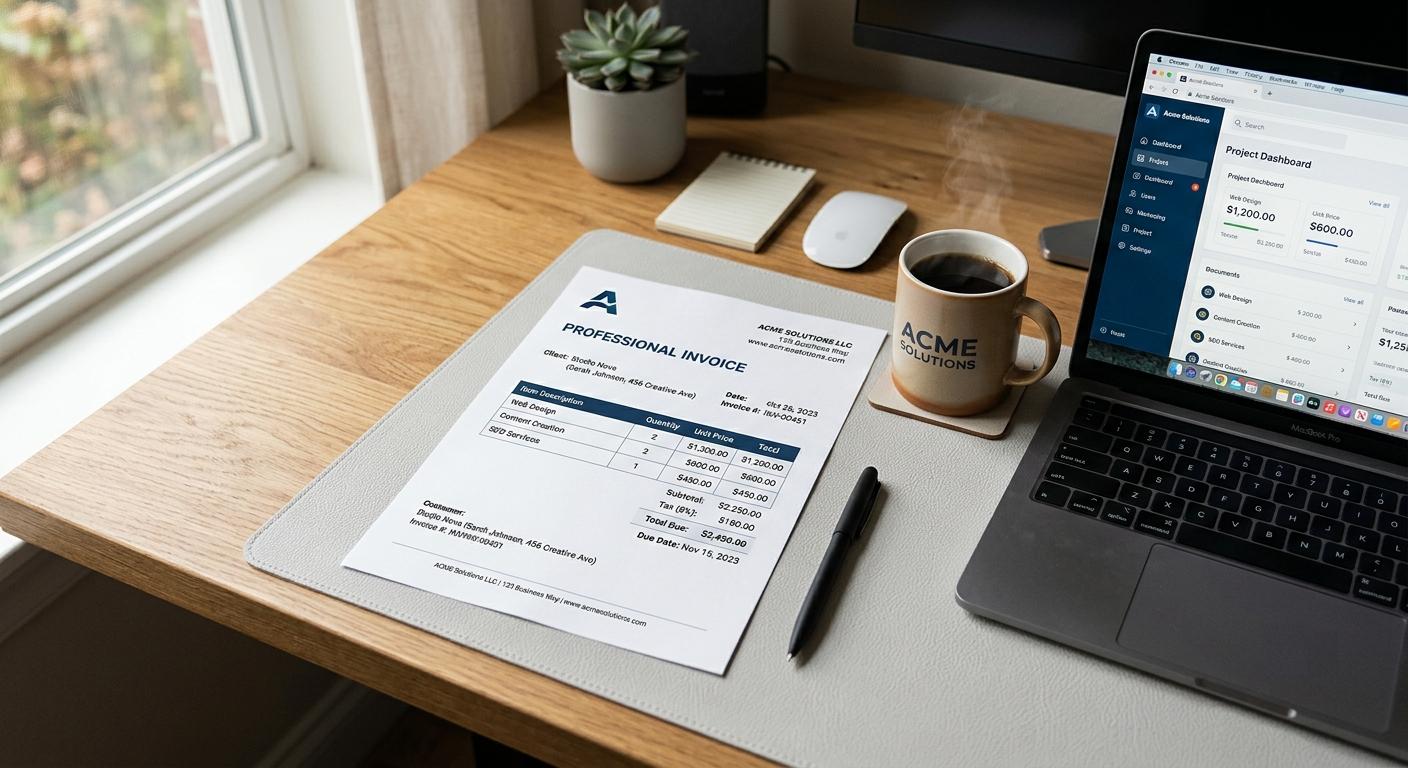
An invoice is a request for payment. You send it to your client. It says what you did, how much it costs, and when you expect to be paid. That's it. No government agency sees it, no tax form is attached to it, and it carries no legal weight beyond "this is what we agreed and this is what's owed."
A solid invoice includes:
- A unique invoice number
- Your name/business name and contact details
- The client's billing details
- A clear description of the work
- The amount, due date, and how to pay
If you want the full breakdown of what belongs on a proper invoice, we've covered that in detail here.
Here's the part people get wrong: your invoice is not a tax document, and you don't need your client's tax details to send one. You can invoice a client on day one without ever mentioning a W-9. The two things are related but not dependent on each other.
What a W-9 actually does
A W-9 ("Request for Taxpayer Identification Number and Certification") is a one-page IRS form. You fill it out and give it to your client, never the other way around, and never to the IRS directly.
It tells your client:
- Your legal name (or business name)
- Your address
- Your taxpayer ID (either your Social Security Number or an EIN if you have one)
- Your business structure (sole proprietor, LLC, S-corp, etc.)
Your client keeps this form on file. They are not required to submit it anywhere. It just sits in their records so that, at year-end, they know exactly how to report what they paid you.
When does a client ask for one? Usually before the first payment, or sometime during onboarding. It's standard, it's not personal, and it's not optional if you want to get paid: most businesses will not release payment to a contractor without one on file, because it protects them if the IRS ever asks who they paid and why.
A common worry: "Does filling this out mean I'll definitely get taxed more?" No. A W-9 doesn't calculate anything, withhold anything, or report anything by itself. It's purely identification. Think of it as the freelance equivalent of showing ID at the bank: necessary, a little dull, and not something to overthink.
What a 1099-NEC actually does
This is the one that shows up months later and catches people off guard, not because it's confusing, but because by the time it arrives, most freelancers have completely forgotten they ever sent a W-9.
A 1099-NEC ("Nonemployee Compensation") is a form your client fills out, not you. If they paid you $600 or more in a calendar year, they're required to send you a copy by January 31st of the following year, and they also send a copy straight to the IRS.
It tells the IRS: "We paid this person this much money, and it's on them to report and pay tax on it." That's the whole point of the form. It's a paper trail, and it exists so freelance income doesn't quietly disappear from view at tax time.
A few things worth knowing:
- You don't create it. If you're issuing yourself a 1099, something has gone sideways: that's a client's job, not yours.
- You might get several. One from every client who paid you $600+ that year. Freelancers working with five or six regular clients can easily end up with a small stack of them by February.
- Getting one (or not) doesn't change what you owe. Even if a client forgets to send a 1099, or you did work for someone who paid you $400 total, you still legally owe tax on that income. The 1099 is a reporting mechanism for the IRS, not the trigger for your tax obligation.
Quick comparison table
| Invoice | W-9 | 1099-NEC | |
|---|---|---|---|
| Who fills it out | You | You | Your client |
| Who receives it | Your client | Your client | You (and the IRS) |
| When | Every time you're owed money | Once, at the start of a working relationship | Once a year, by Jan 31 |
| Purpose | Request payment | Share your tax ID with a client | Report what a client paid you |
| Goes to the IRS? | No | No | Yes |
The order these things actually happen in
Here's where it clicks for most people: seeing the timeline laid out instead of three separate definitions.
- [ ] You land the client. Before any money changes hands, they ask for a completed W-9.
- [ ] You send the W-9. One form, filled out once. You don't resend it for every project unless your details change.
- [ ] You do the work and send an invoice. This happens every time you're owed money: weekly, monthly, per project, however you've structured it.
- [ ] You get paid. The invoice's job is done. It has nothing further to do with anything.
- [ ] January rolls around. If that client paid you $600 or more across the year, they send you a 1099-NEC, with a copy going to the IRS.
- [ ] You use the 1099 (and your own invoice records) to file your taxes. The 1099 tells you what the client reported. Your invoices and bank records tell you what you actually made overall, which matters, because you should be reporting all your freelance income, not just the parts that show up on a 1099.
That last point matters more than people realize. Your own tax obligation isn't defined by which 1099s land in your inbox. It's defined by what you actually earned. Keep your own invoice records regardless of whether a form ever arrives to match them.
Where people genuinely get tripped up
"A client asked for my W-9 before I'd even sent an invoice, is that normal?" Yes, completely. It usually happens during onboarding, before the first project even kicks off. It's not a sign they don't trust you; it's just paperwork they need on file before payments start.
"Do I attach my W-9 to every invoice I send?" No. Send it once, when asked, and keep a copy for yourself. Attaching it to every invoice is unnecessary and honestly looks like you're not sure how any of this works.
"I never got a 1099 from one of my clients. Does that mean I don't owe tax on that money?" No. If they paid you and you earned it, you owe tax on it whether or not a 1099 ever shows up. Some clients under the $600 threshold aren't required to send one at all. That doesn't erase the income.
"My invoice already has my business name and address on it. Isn't that enough?" Not for tax purposes. An invoice tells a client what they owe. A W-9 tells them your legal taxpayer information for their IRS filing. They serve completely different functions, even though they might list some of the same details.
"I'm an LLC. Do I still need to fill out a W-9?" Yes, generally. Your business structure just changes which boxes you tick on the form (and whether you use your SSN or EIN). It doesn't exempt you from providing one.
"What if a client never asks for a W-9 at all?" Some smaller or newer clients simply don't know they need one, or the work fell under the reporting threshold. It's worth proactively sending one anyway if you expect to be paid $600+ over the year. It saves an awkward scramble in January when they suddenly need your tax ID to file.
The takeaway
None of these three documents replace each other, and none of them are optional once triggered by circumstances. An invoice gets you paid. A W-9 hands over your tax ID once. A 1099 is your client reporting what they paid you, once a year, to the IRS.
Keep a folder, digital or otherwise, with your W-9 template ready to go, and every invoice you've ever sent, itemized and dated. Between your own invoice records and the 1099s that show up each January, you'll have a complete, defensible picture of your income whenever tax season comes around.
And if you're still sending invoices as a Word document with your bank details buried in a footer somewhere, that's an easy fix. Use our free invoice generator to put together a clean, professional invoice in a couple of minutes: no account, no watermark, just a proper PDF with everything a client (and eventually your accountant) needs to see clearly.